Did you know that “visual fixation” is one of the most important signs of your child’s neurological and visual development?
Vision, like the brain and many of its functions, is not fully developed when a child is born. When the baby opens their eyes and receives the stimulus of light, the eye and vision begin to mature, progressing rapidly and reaching maturity in the first years of life. The eye is only a receiver, similar to a video camera: it captures the light coming from objects, modulates it and turns it into a nerve signal that the brain will turn into an image. Each eye sees objects from a different angle, and the brain combines these different images into a single one, giving us perspective, or binocular vision.
So we see with the brain, and when we look at an object, for example a jacket in a pile of clothes, we know where it is, what it is for, its color, shine, size and shape; we can say who it belongs to, and even remember who gave it to them, when and where it happened, and the emotions connected to that event.
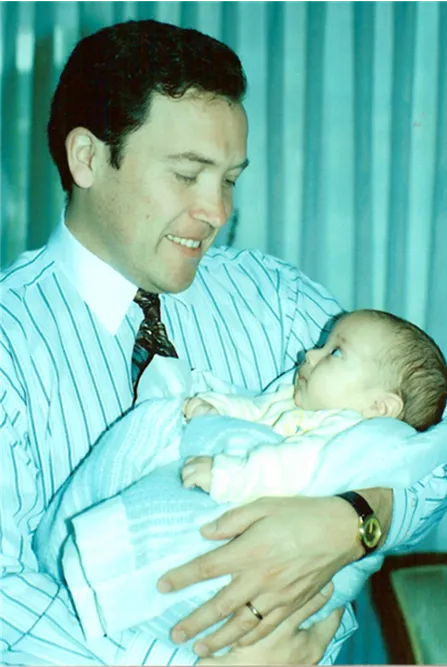
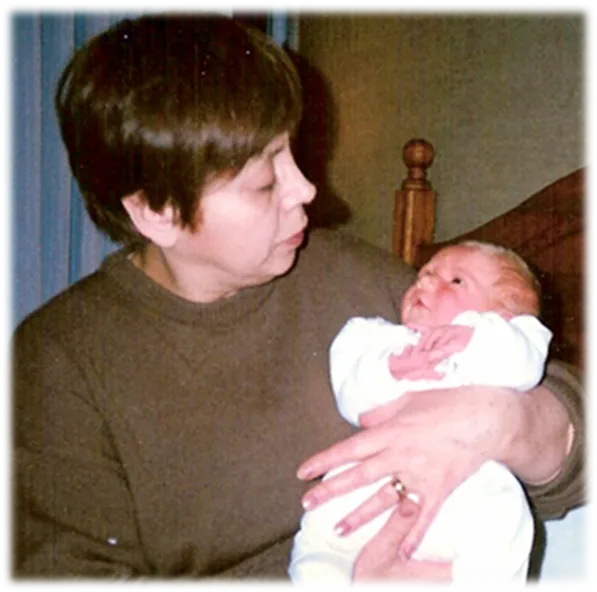
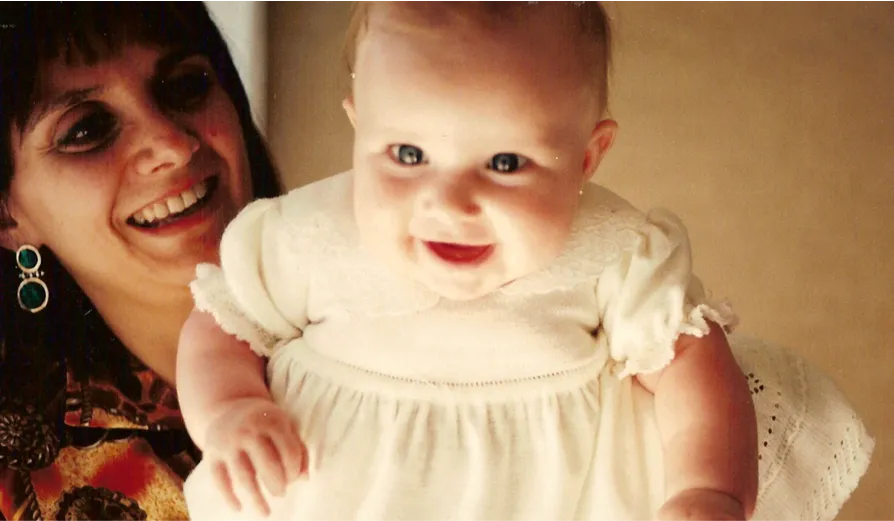
The baby looks at the mother’s face while feeding, fixes on and follows the faces of the father and siblings. Look at photo 1: a father and his son, just days old, make eye contact, and photo 2: a grandmother and her granddaughter hold each other’s gaze. In a healthy baby, “visual fixation” should be present by 2 months of age.
This eye contact should be sustained, last long enough to show attention, and follow the movement of objects or faces.
If you notice any repetitive or rhythmic movement, or if your child does not fix their gaze and is already 3 months old, you should see the pediatrician right away so they can examine your child and decide whether a specialist should assess them
With the stimulus of light, the eye and the brain develop rapidly
The first sign to watch for is that the baby makes eye contact with you, the father, grandparents, siblings.
Socialization, learning and vision
Through vision, children learn to interpret gestures and imitate them, for example a smile (see photo No. 3). They learn to find out what others feel, to recognize their own face and body and tell them apart from those of others. They recognize their belongings, explore their surroundings and get to know the world.
Good vision is very important for play, walking and sports, as well as for developing language, writing and reading.
- They learn to feel what others feel,
- to recognize their own face and body and those of others
- To recognize their belongings
- To explore their surroundings
Plasticity
We know that while a child is maturing, the development of the eye, the visual pathway and the brain can be changed both positively and negatively.
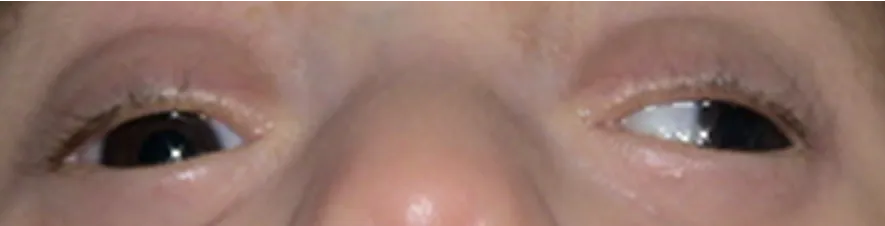
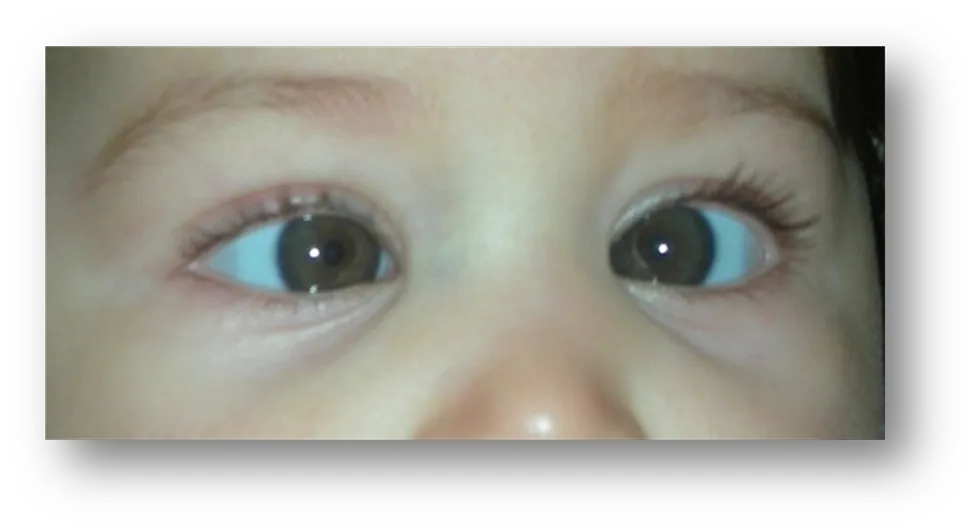
For example, if a child is born with a turned eye, or strabismus, the child will see double and be confused, and the brain will “switch off,” or suppress, the more turned or weaker eye. Look at photo 4, which shows two children with turned eyes, or strabismus: 4.a a newborn with divergent strabismus and 4.b an infant with convergent strabismus.
If this is not corrected in childhood, the brain will finish maturing and the child will never use the weaker eye again. This is what is called “lazy eye,” or amblyopia, and it can only be reversed with rigorous treatment in the first years of life.
If, unfortunately, the child loses their only good eye in an accident, the affected eye will not recover its vision. This is why it is so important to detect any problem in the development of vision
The eyes should be aligned and move in the same direction at the same time.
Any strabismus or permanent eye turn is ABNORMAL
There may be some occasional, temporary lack of coordination in eye movements, but only up to 6 months of age
4.A look at the left eye of a newborn, turned outward (divergent)
4.B look at an infant with convergent strabismus of the right eye, turned inward
Notice that the light reflex is not in the center of the pupil
The red reflex test
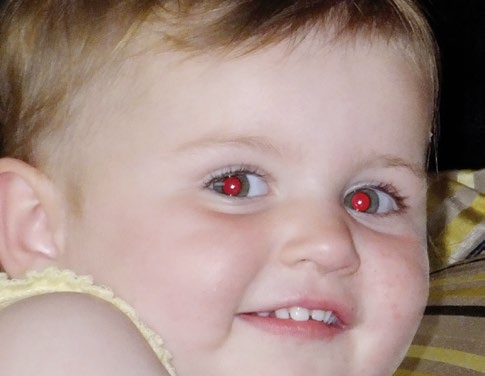
The red reflex test consists of shining a light into the child’s pupils and looking at the light that is reflected. Look at photo No. 5 a and b. You have surely noticed red eyes in family photos when a flash is used.
If one or both pupils look WHITE, you should see a doctor right away
Normally, when both eyes are looking toward the light, the pupils look evenly orange or red. If one or both pupils, or part of them, look white, it is urgent to have the child seen to rule out eye or general diseases. Photo 5 b: white pupils caused by malignant tumors.
Take photos with the flash and without red-eye removal, at least until age 3. (Photo 5 a)
Significant refractive errors often go unnoticed by parents, teachers and even the child, until a later age. Remember that the child has no previous experience of “seeing well” and is used to their situation. It is not unusual for teenagers to come to the ophthalmologist for the first time after covering one eye while playing and realizing they cannot see out of one eye.
Every healthy child should have routine eye health check-ups throughout their development, from birth to adolescence. If anyone in the family wears high-prescription glasses, or has strabismus, eye diseases, etc., the child should be monitored by an ophthalmology specialist from birth.
If the child is healthy and the parents and/or pediatrician do not notice any problem, a routine specialist exam before age 4 is recommended. During this exam, the ophthalmologist will measure the visual acuity of each eye, rule out the need for glasses, test color vision and check three-dimensional vision, or binocular vision. 3D vision is needed for many activities, such as being a surgeon or dentist, specialized driver’s licenses, etc., and it requires both eyes to have excellent acuity and be perfectly aligned.
If any problem is detected, follow the doctor’s instructions strictly, because the later treatment starts, the harder it will be to achieve normal visual development.